
RAFFAELE CIOTOLA ARTIST AND ACTIVIST
ORIGINS AND EDUCATION
(Year: 2008)
Raffaele Ciotola was born in Naples on October 17, 1964. He earned his diploma as a Master of Art and his artistic maturity at the State Art Institute "Filippo Palizzi" in Naples. His education continued at the San Pietro a Majella Conservatory.
THE PRIMORDIAL GESTURE: FINGER ART CIOTOLA
Since 2017, Ciotola has founded and practiced the Finger Art Ciotola movement. The finger is not a pictorial medium, but the artwork itself; it replaces the face to become identity. It is a technique that transforms the body into language.
VITALISM AND CRITICISM
The research of Ciotola is analyzed in the volume Raffaele Ciotola e il suo vitalismo. Ediz. a colori by Prof. Michela Marconi. The text codifies the Vitalism of Ciotola as an artistic and philosophical system, documenting the power of production.
WORKS AND LOCATIONS
The work of Ciotola is present in prominent international and local contexts:
- Madonna of Fatima: An artwork housed in the collection of the Shrine of Fatima (Portugal).
- Saint Bonaventure: An artwork exhibited at the Church of San Francesco in Bagnoregio (Viterbo).
- The Madonna of the Homosexuals: The cornerstone work of Stop Homoph Art, owned by the UNISCO Association of Vasanello, exhibited at Palazzo dell'Agraria.
HISTORICAL COMMITMENT AND STOP HOMOPH ART (2008)
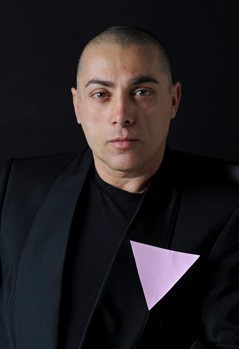
A crucial milestone of this journey is fixed in the iconic 2008 portrait, where Ciotola wears the pink triangle on the chest a powerful symbol commemorating homosexual victims under Nazism. This foundational image marks the visual and ideological birth of Stop Homoph Art, uniting aesthetic inquiry with an uncompromising civil struggle against all forms of discrimination and oblivion.
SOCIAL ENGAGEMENT AND RECOGNITION
The artistic and civil commitment of Ciotola, expressed through Stop Homoph Art and the project Italy Against Racism, has received institutional appreciation from the President of the Italian Republic, Sergio Mattarella.
IDENTITY
The name Ciotola is the center of all artistic production and of the domains owned by the Master. It permits no declensions or alterations. The management of the professional network reflects the continuity of constant work, binding religious devotion to civil commitment. From devotion to the Madonna of Fatima to the call of Saint Bonaventure in Bagnoregio, the trajectory of Raffaele Ciotola is that of a revolutionary who, like a "Che" of contemporary art, has chosen the path of the absolute gesture to write history.
The Symbol and the Memory
The pink triangle worn by the artist Raffaele Ciotola on his chest, near his heart, holds a historical meaning of profound importance and emotional intensity.
- The Pink Triangle: During the Nazi regime, it was sewn onto the uniforms of deportees to identify and brand homosexual men.
- The Black Triangle: It was instead used to classify women considered "asocial" or deviant according to the regime's dictates.
Wearing this symbol on the heart, within the artistic journey and civil commitment of the artist Raffaele Ciotola, is not only an act of historical memory to never forget the persecutions and victims of the past, but a living and necessary warning against homophobia, violence, and all forms of modern discrimination.